
Healthcare has always been built on trust, expertise, accessibility, and communication. Today, the way people find and evaluate healthcare providers is changing. Before choosing a doctor, clinic, hospital, diagnostic centre, dental practice, physiotherapist, or other healthcare service, many people first look for information online.
This makes a healthcare organisation’s online presence an important part of how patients discover services, understand what is offered, and decide how to take the next step.
A website can play an important role in this process—not simply as an online brochure, but as a central source of reliable information for patients and their families.
How People Search for Healthcare Information Today
When people have a healthcare concern, they often search online for information such as:
- Doctors and specialists in their area
- Available medical services
- Clinic or hospital locations
- Consultation timings
- Diagnostic and laboratory services
- Treatments and procedures
- Frequently asked questions
- Contact information
- Emergency or appointment information
For many people, the first interaction with a healthcare provider may happen online rather than at the reception desk.
A clear and informative digital presence helps people understand who you are and what services you provide before they make contact.
A Website Can Become a Reliable Information Point
Healthcare information needs to be clear and easy to understand. A dedicated website gives a healthcare organisation a place where important information can be presented in an organised manner.
For example, a healthcare website can provide information about:
- Doctors and their areas of expertise
- Medical departments
- Treatments and procedures
- Diagnostic services
- Clinic facilities
- Consultation timings
- Locations and directions
- Frequently asked questions
- Contact details
- Appointment-related information
Instead of patients having to search through different platforms, they can find important information in one central location.
Building Trust Through Useful Information
Trust is particularly important in healthcare.
Patients may want to know about a healthcare professional’s qualifications, experience, areas of specialisation, available services, and approach before contacting them.
Providing this information clearly can help patients make more informed decisions.
Educational content can also be valuable. Articles explaining common procedures, preventive care, treatment preparation, recovery information, or frequently asked questions can help people better understand healthcare topics.
The goal is not to replace professional medical advice. Rather, useful information can help patients know what questions to ask and when professional consultation may be appropriate.
Helping Patients Understand Your Services
Healthcare organisations often provide multiple services, but patients may not always know what is available.
For example, a multispeciality clinic may provide:
- General medicine
- Paediatrics
- Orthopaedics
- Gynaecology
- Physiotherapy
- Diagnostics
- Preventive healthcare
If these services are clearly explained online, visitors can better understand whether the organisation provides the type of care they are looking for.
Clear service information can also reduce repetitive enquiries about basic details.
Making Important Information Available 24/7
A clinic or hospital has specific working hours, but people search for information at all times of the day.
A website can make basic information available even when the reception desk is closed.
Patients can check details such as:
Where are you located?
What services are available?
What are the consultation hours?
How can I contact the clinic?
Which specialist provides a particular service?
Having these answers readily available can make the initial information-gathering process easier.
Local Visibility Matters for Healthcare Providers
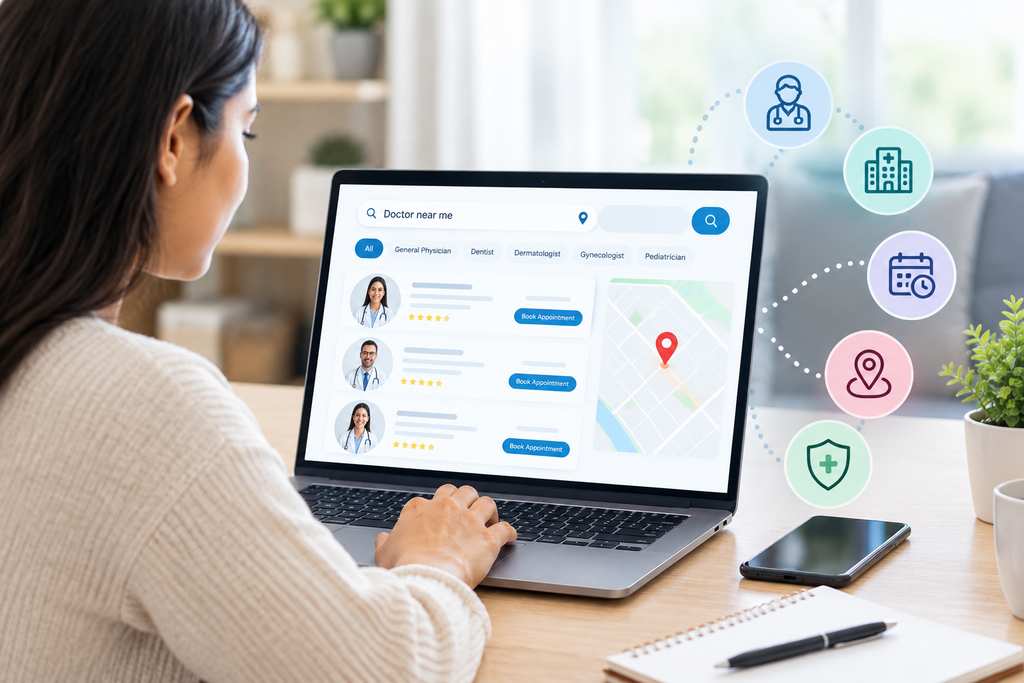
Healthcare is often location-based.
A person searching for a dentist, physiotherapist, diagnostic centre, paediatrician, or specialist is frequently looking for services within a particular city or neighbourhood.
Providing accurate information about locations, services, timings, and contact methods helps people understand whether a healthcare provider is accessible to them.
Consistent information across the organisation’s online presence can also make it easier for people to identify the correct healthcare facility.
Supporting Better Patient Communication
A website can also act as a communication channel between a healthcare organisation and its audience.
Important announcements can be shared online, including:
- Changes in consultation timings
- New services
- New specialists
- Health awareness programmes
- Preventive healthcare information
- Clinic holidays
- General patient instructions
This can help reduce confusion and keep patients informed.
Educational Content Has a Long-Term Value
Healthcare organisations have an opportunity to provide genuinely useful educational information.
For example, a physiotherapy practice could publish articles about posture, rehabilitation, or recovery.
A dental practice could explain preventive dental care, oral hygiene, or common dental procedures.
A diagnostic centre could explain how patients should prepare for commonly performed tests.
A hospital could publish general health awareness information, department details, and explanations of available services.
Such content can answer common questions while also helping people understand healthcare topics in simpler language.
Of course, healthcare content should be accurate, responsibly written, and should not be presented as a substitute for individual medical diagnosis or treatment.
Helping Family Members Make Decisions
Healthcare decisions are not always made by the patient alone.
Family members frequently research doctors, hospitals, clinics, and treatments on behalf of children, elderly parents, or other relatives.
Having comprehensive and easy-to-understand information available online can help family members compare practical details such as location, services, specialists, and contact information before making an enquiry.
A Digital Presence Reflects Organisation
Patients often form an initial impression based on the information they encounter online.
An organised online presence can make it easier to understand:
- Who the healthcare provider is
- What services are offered
- Where the facility is located
- Who the specialists are
- How to get in touch
- What information is important for patients
This is particularly useful when someone is discovering a healthcare provider for the first time.
Website Information Should Be Kept Updated
Having information online is useful only when that information remains accurate.
Healthcare organisations should periodically review details such as:
- Doctor profiles
- Contact numbers
- Addresses
- Consultation timings
- Services
- Department information
- Appointment instructions
- Frequently asked questions
Outdated information can create unnecessary confusion for patients.
An accurate and regularly maintained online presence is therefore more useful than simply having an online presence.
The Bigger Picture: Healthcare Is Becoming More Information-Driven
The role of digital information in healthcare continues to grow.
People are becoming more accustomed to researching their options, understanding services, reading educational material, checking practical details, and preparing questions before speaking with a healthcare professional.
For healthcare organisations, this means their online presence can serve an important informational purpose.
It can help bridge the gap between someone looking for healthcare information and someone ready to communicate with a healthcare provider.
Final Thoughts
For healthcare professionals and organisations, an online presence is about more than simply being visible on the internet.
It can provide patients with reliable information, explain available services, introduce healthcare professionals, answer common questions, communicate important updates, and make essential details accessible at any time.
A well-organised digital presence can therefore become an extension of the information and communication that healthcare organisations already provide offline.
In an industry where trust, clarity, and accessibility matter, making accurate healthcare information easy to find can be valuable for both patients and healthcare providers.